
The West Hollywood City Directory Shelf
There is no long-running pre-1984 municipal West Hollywood directory series. The useful shelf is the Los Angeles and Hollywood regional set that included the unincorporated community under older place names. LAPL reports city-directory coverage from 1873 to 1970 and reverse-directory coverage for 1906, 1927, and 1956 through 1987. The table keeps the collection, years, location, and access level together so a search begins with the right container.
| Collection | Years or examples | Where held | Access |
|---|---|---|---|
| Los Angeles city directories | 1872 onward in historical runs; digitized 1873-1970 coverage | LAPL Central Library and ResCarta | Free scans plus paper and microform runs |
| Hollywood city directories | 1906 volume verified | LAPL ResCarta | Free scanned browse |
| Los Angeles County telephone directory | 1904 example | LAPL ResCarta | Scanned subscriber listings |
| Street and reverse directories | 1906, 1927, 1956-1987 | LAPL City and Street Directories | Free online scans where digitized |
| Federal population schedules | 1790-1950 released | NARA, FamilySearch, library databases | Name and enumeration searches |
| Sanborn fire-insurance maps | Edition and sheet specific | Library of Congress and LAPL | Building context, not occupants |
| Newspapers and obituaries | Title-specific historical runs | LAPL databases and microfilm | Address, family, legal, and society clues |
A volume is a published snapshot. The listed person may be a householder, boarder, subscriber, business contact, or someone reached by the canvass. The record is strongest when its year, page, street form, and abbreviation key are saved with the image.
West Hollywood City Directories Before 1984
West Hollywood's historical directory problem is a geography problem. The settlement grew as Sherman around the Los Angeles Pacific Railroad yards, took the West Hollywood name in 1925, and remained unincorporated county territory until November 29, 1984. A resident did not need to move for a directory, census entry, or local reference to use a different community label. Search older records with Sherman, Hollywood, Los Angeles, and Los Angeles County variants.
Before incorporation there was no City of West Hollywood Clerk series for permits, ordinances, or city directories. Earlier address evidence comes through county files, regional directories, census enumeration districts, newspapers, and historical map collections. After cityhood, municipal permit and planning records become a new source layer, but they do not replace the regional books.
This history also explains why a blank result can be misleading. A 1920s address may be indexed in a Hollywood volume. A postwar street may be listed in Los Angeles or a reverse directory that includes selected county communities. Search the book's scope statement and street guide before treating the absence of a West Hollywood heading as proof that the volume does not cover the place.
| Year | Directory and place-name milestone |
|---|---|
| 1872-1873 | Rare early Los Angeles directory material begins the regional shelf. |
| 1925 | Sherman is renamed West Hollywood in local historical references. |
| November 29, 1984 | West Hollywood incorporates, creating a city record layer. |
| 1990 | The first decennial census after incorporation covers the city as an incorporated place. |
The LAPL ResCarta directory browser is the practical place to test older titles and regional spellings.
1906 Hollywood Directories for West Hollywood
Two 1906 titles are especially useful: Hollywood City Directory and Baumgardt's Hollywood city directory, Los Angeles County, California. The same year also supplies the Los Angeles Street and Avenue Guide. Pairing the directory with the street guide can explain an abbreviated road name, a numbered street form, or a community label that does not map cleanly to a modern West Hollywood address.
Use the scan's title page, publication date, publisher, page, and abbreviation key. Check both alphabetical and street sections if the volume has them. A directory may list a person under a spouse, show a business separate from a residence, or omit a non-subscriber from a telephone volume. The guide is a bridge between the old form and the current parcel, not a substitute for a deed.
The scanned browse collection is the source for the 1906 Hollywood titles and street guide used in a West Hollywood volume search.
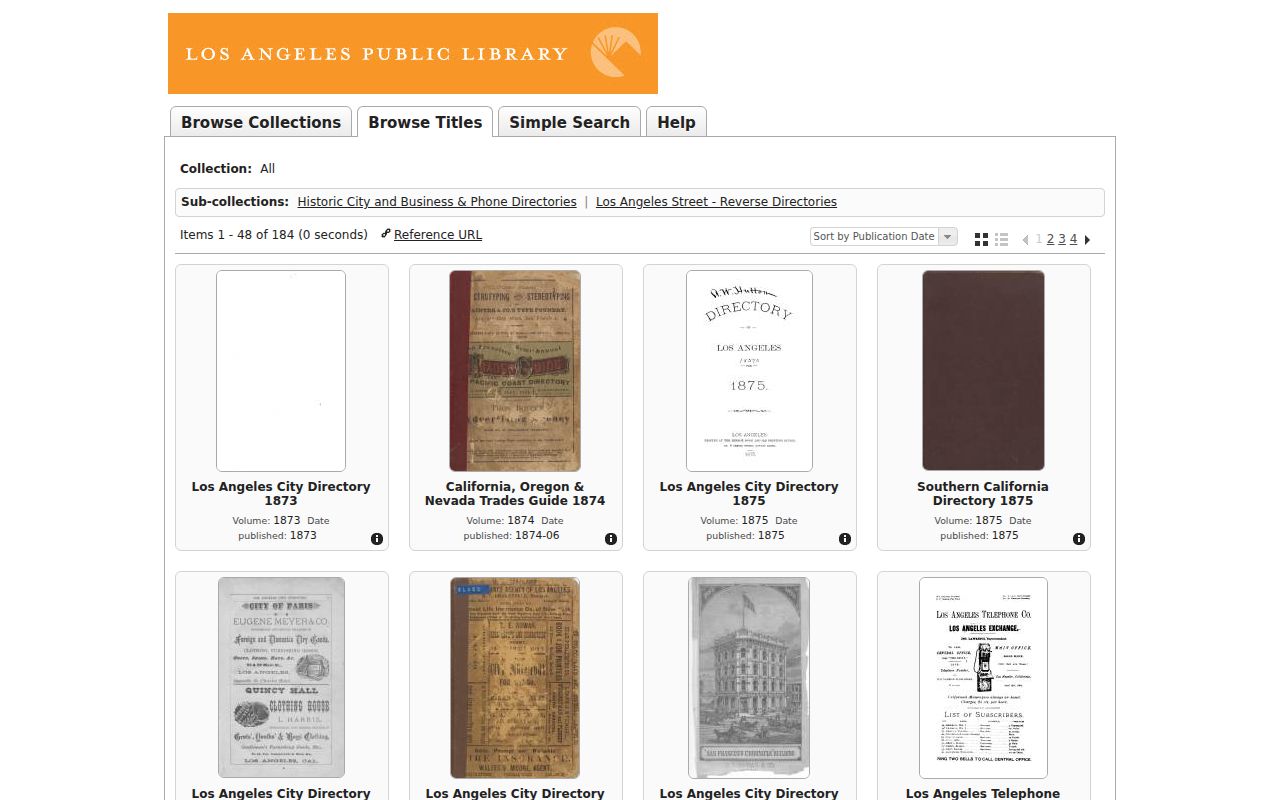
The image represents the browse-first method. When OCR misses an address, move through the page image and use the printed key instead of trusting a blank text search.
The Digitized West Hollywood Directory Run
LAPL's digital collection includes Los Angeles City Directory volumes from the late nineteenth and twentieth centuries, later Polk and other publisher runs, the county telephone directory, street guides, and reverse directories. ResCarta exposes Browse Titles, Simple Search, Help, and deeper search controls. Visible examples include 1899, 1900-01, 1901, 1902, 1904, 1906-07, and 1907 volumes. The collection is broad but not a guarantee of a full year-by-year run for one address.
Search by surname, business type, street, or exact phrase, then browse neighboring pages. OCR can break street numbers, abbreviations, and names. The printed page remains the citation. Record the volume title, cover year, page and column, publisher, and any note that the book was canvassed before its cover date.
LAPL's guide to digitized city and street directories explains the 1873-1970 city-directory and 1906, 1927, 1956-1987 reverse-directory scope used here.
A directory search earns more trust when an image citation survives even if a later interface changes its search fields.
Reading a West Hollywood City Directory Entry
Directory notation is compact. Read the abbreviation key before interpreting an entry, and do not expand a mark from memory. The same line can carry a name, spouse, address, work or business reference, and a household marker. A telephone volume may show a subscriber and exchange while omitting someone with no listed service. A reverse section may place a street number before an adult or business.
- Criss-cross directory
- An address-first directory that arranges entries by street, block, and number before the listed adult or business.
- Householder index
- A person or household listing used to locate a residence in an alphabetical or street section.
- Abbreviation key
- The volume's own guide to short forms such as h, r, wid, street names, and business notation.
- Canvass date
- The period when listings were gathered, which may precede the volume's cover year.
A typical entry may include surname and given name or initials, a spouse in parentheses, wid for widow or widower, an occupation or business, residence street and number, and a page or column. Copy the exact wording. It is evidence of a listing at publication time, not proof of ownership or current presence.
| Visible field | How to use it |
|---|---|
| Name and initials | Compare variants and same-surname adults. |
| Spouse or wid notation | Suggests a family event, subject to confirmation. |
| Occupation or business | Provides historical context, not a current identity proof. |
| Street number and name | Links the entry to a place at that volume's date. |
| Page, column, and volume | Preserves the citation for another researcher. |
West Hollywood Reverse Directory Years
Reverse directories make an address the starting key. LAPL identifies 1906, 1927, and 1956 through 1987 runs, with publishers and coverage varying by volume. Some include selected Los Angeles County communities. The street section can reveal a listed adult, business, or address sequence that an alphabetical search misses. It can also expose a different street abbreviation or a place name that needs the 1906 guide.
A practical address search tries the current street, older street form, nearby cross street, and number variants. Look for h or r marks, numbered-street spellings, and a separate business section. If an entry is absent, consider canvass timing, no telephone, an unlisted line, an address change, a parcel split, or OCR failure before concluding that the address was empty.
LAPL's house-history guide connects directory work with deeds, newspapers, voter registrations, and property datasets. It also warns that deeds require grantor and grantee names rather than a simple address search.
The house-history source is a useful companion to the volume because it keeps the address trail and its source limits together.
Pairing West Hollywood Directories With Census
The federal population schedules released through 1950 provide household relationships, ages, birthplaces, and enumeration geography that a directory may not. The 1890 federal schedules were largely destroyed in the 1921 Commerce Department fire, making annual directories especially valuable for families who lived between surviving census years. The first decennial census after West Hollywood incorporated was 1990, so earlier research remains regional.
Pair a directory from a known address with the closest released census. Compare surname, street, household members, ages, birthplace, and occupation. A census can differ from a directory because the enumerator visited on a different date, a family moved, a person was away, or an address was abbreviated. Preserve both entries rather than forcing them into one version.
The Census Bureau's historical disclosure information explains the release context and the 72-year rule. Use NARA, FamilySearch, or a library database for the actual schedule search.
The census source adds household detail, while the directory supplies an annual bridge and a street spelling to compare.
Research Help for West Hollywood Directory Work
West Hollywood Library at 625 North San Vicente Boulevard is a Los Angeles County Public Library branch with newspapers, local service, an LGBTQ+ collection, Russian-language materials, and the Ron Shipton HIV Information Center. Its local history value is real, but the comprehensive directory shelf belongs mainly to LAPL Central Library's History and Genealogy Department at 630 West Fifth Street in Los Angeles. LAPL describes about 52,000 genealogy titles, Los Angeles directories in paper and film, about 1,000 U.S. city directories in hard copy, and more than 5,000 microfilm rolls for U.S. cities from 1861 to 1960.
Library-card or in-building rules apply to licensed genealogy databases and newspaper products. Reference staff can help locate a title, but a scan, shelf mark, page, and volume date should still be recorded. FamilySearch catalog searches work best with California, Los Angeles, and a record type. Some images are browse-only or require a FamilySearch center or affiliate library.
LAPL's genealogy guide routes a West Hollywood collection search toward census, vital indexes, newspapers, databases, and reference help.
The local and central library roles complement each other: one supplies nearby help and community material, while the other holds the deep regional directory shelf.
West Hollywood City Directory Addresses and Sanborn Maps
A Sanborn fire-insurance map is not a residents directory. It can show a building footprint, construction material, use, street number, lot pattern, and nearby structures at the map's edition date. LAPL's research notes place West Hollywood generally in Sanborn volumes 10 and 20, but exact sheet and edition coverage must be confirmed through the master address index. The Library of Congress collection provides a second catalog and scan route.
Use the master address index, then volume and sheet, then the map itself. Compare its footprint and street form with the directory entry and the assessor parcel. A change in footprint can explain a later address or unit clue. The map cannot identify an owner, occupant, or complete household. That answer belongs to the deed, directory, census, or probate source that covers the same date.
The Library of Congress Sanborn collection is the appropriate map archive. LAPL's map librarian can help with the local volume, but an exact sheet should never be invented when the index is unclear.
Trace a West Hollywood City Directory Household Across Years
A year-by-year sequence turns a directory volume into a family-history source. Start with one known entry and move through available volumes in small steps. Keep every change visible. A sudden absence can be a move, a marriage or widowhood notation, a name variant, a new community label, or a gap in the collection. Use a deed, probate, obituary, or census only after the directory sequence supplies a date and address to test.
- Copy the exact entry, address, page, volume year, publisher, and abbreviation key.
- Search the next available volume by surname and by the old and new street forms.
- Compare the entry with the closest released census for household relationships and ages.
- Check newspapers, vital indexes, probate, or a deed when a household member disappears or changes role.
- Write a conclusion that states whether the record shows a listing, ownership, kinship clue, or only a possible match.
The result is a sourced timeline, not a claim that one directory captures everyone at an address. That distinction keeps the West Hollywood collection useful for descendants, reunion research, and local history while respecting the gaps built into historical publications.