
West Hollywood Street-by-Street Walkthrough
A street search works best as a chain. Begin with the complete address, including a unit or directional prefix, and keep the exact form beside any normalized version. West Hollywood uses a regional Los Angeles numbering framework, while older records may call the community Sherman, Hollywood, or Los Angeles. The first objective is not to name a person. It is to establish the parcel, the legal description, and the dates that let separate custodians be compared.
- Run the address through the Los Angeles County Assessor Property Search and record the AIN, situs, legal clues, and property type.
- Open the county GIS viewer, click the target parcel, then note adjacent AINs in a clockwise pass.
- Use the parcel and current party clue to prepare a name-and-year search at the Los Angeles County recorder's Norwalk index.
- Check city permit and planning records for project dates, applicants, contractors, and address changes.
- Use a historical reverse directory or alphabetical directory when the question concerns a past listed household.
The order matters. A recorder search cannot start with a street number, and a directory listing cannot answer present ownership. Keeping the tracks separate produces a stronger West Hollywood street directory record.
West Hollywood Street Directory Fields for an Address
The Assessor is the practical address-to-parcel bridge. Its Basic Search accepts an AIN or address. A Legal Search accepts an assessment legal description, which may not be the complete legal description in a deed. A map search opens the parcel viewer. The result can show AIN, address, legal and map clues, property type or use, characteristics, assessed values, and displayed history. Public online owner-name searching is limited by California privacy practice, so the portal should not be described as a name-indexed address list.
| Field or control | Type | What it returns |
|---|---|---|
| Search by AIN or Address | Single text field | Ten-digit AIN or street address, followed by parcel results. |
| Assessment Legal Description | Single text field | Assessment description used to narrow a parcel. |
| Map Search | Tab or button | Opens location-based parcel browsing. |
| Parcel result | Detail view | AIN, situs, legal clues, use, characteristics, and value fields. |
The portal's situs is the physical assessed site. A tax mailing address is a different field. A matching mailing and situs may support an ownership clue, but it does not prove that the owner is present. A large multifamily parcel can contain many households that never appear in the roll.
The LA County parcel map used for the address record shows the map-based starting point for a West Hollywood address.
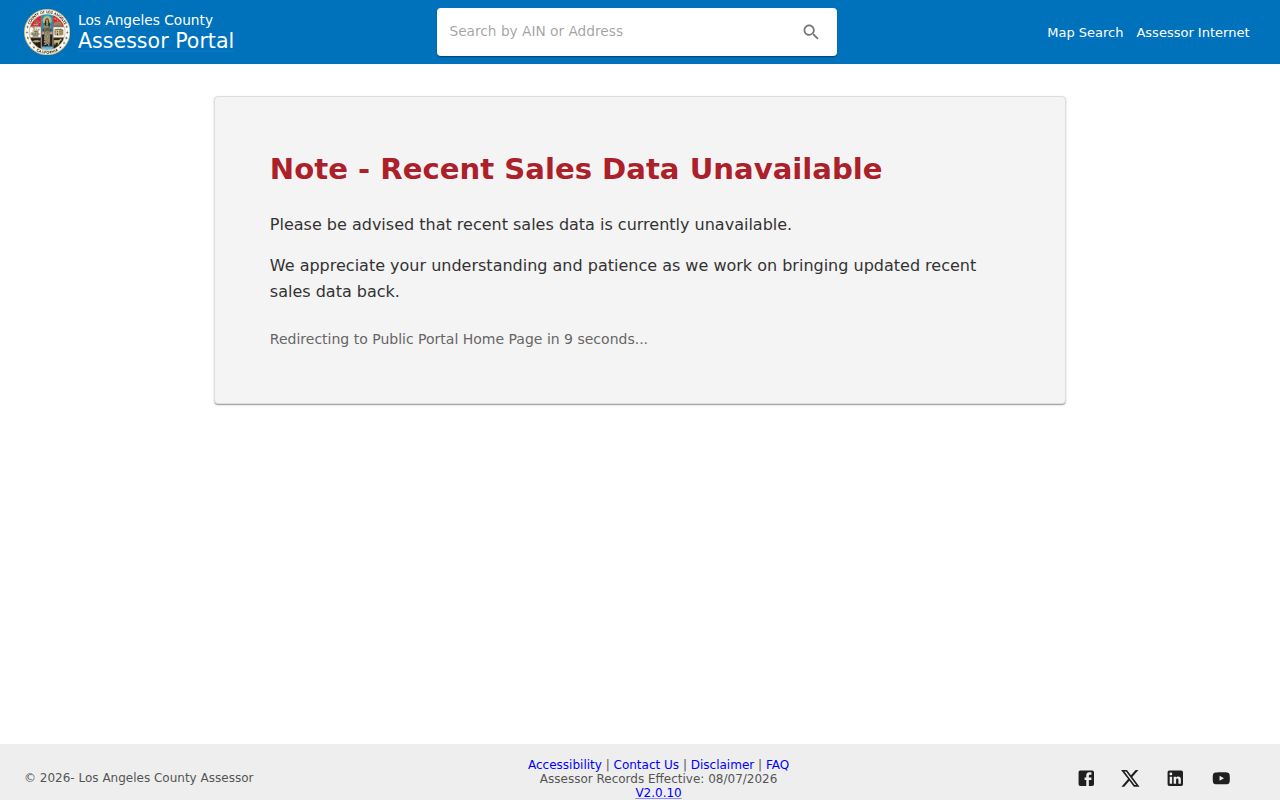
Use the map to create a parcel list, then open each detail separately. The viewer provides geography, not a legal survey or a complete list of people.
- Parcel
- A defined piece of land identified by an AIN and a legal or map description.
- Situs address
- The physical assessed location, distinct from a tax mailing destination.
- Plat
- A recorded map or subdivision reference that helps connect lots, blocks, and parcel changes.
- Criss-cross directory
- An address-first book that lists a street, number, and a historical adult or business.
West Hollywood Records Searchable by Street
Some records key cleanly to an address. Others require a translation from address to AIN, party, year, or document number. This coverage table keeps those differences visible. It also shows why one address search cannot be reduced to one county search box.
| Record set | Keeper | Address or block clue | Access |
|---|---|---|---|
| Assessment parcel detail | LA County Assessor | AIN, situs, use, characteristics, values | Free address/AIN portal |
| Parcel GIS | LA County Assessor/GIS | Boundaries, adjacent AINs, map context | Free interactive viewer |
| Recorded deeds and liens | RR/CC Recorder | Legal interest after party/year translation | Office index; paid copies |
| Secured tax bill | Treasurer and Tax Collector | AIN, tax year, payment or delinquency | Online by AIN |
| Permits and plans | West Hollywood City Clerk/Building and Safety | Address, project scope, applicant, dates | Portal plus focused request |
| Reverse directory | Los Angeles Public Library | Listed adult or business by street number | Scan, shelf, or reference help |
| Voter Street Index | LA County Elections | Geographic voter file under a controlled purpose | Application and contract |
The AIN ties the assessor, map, tax, and permit tracks together. The recorder uses grantor, grantee, and year. The historic reverse directory uses a street number and publication date. The voter file uses residence and identity fields under a restricted purpose. A good address guide notes the key used by each source rather than forcing every result into an address label.
West Hollywood Street Records in GIS Blocks
The parcel viewer supports a block walk without pretending to show every person. Search or zoom to the target address, click the parcel, record its AIN and attributes, then click adjacent polygons. Pan across the street and repeat. The map can reveal a corner parcel, a split lot, a condominium pattern, or a single large parcel whose internal households are not visible in the assessment roll. Measure and print tools help preserve a research view, but the map is not a boundary survey.
For a whole street segment, make a short sheet with the standardized situs, parcel polygon, AIN, mapbook and page clues, property or use type, and each adjacent parcel's AIN. Then follow selected AINs to the assessor detail. This is more reliable than assuming a street number runs one record at a time. West Hollywood's dense, varied parcel pattern makes unit-level matching especially important.
The GIS result is an index to land, not an index to household members. It can support a records request by giving the City Clerk or Assessor a precise address and AIN. It can also prevent an address error when a postal address falls outside the incorporated city line.
West Hollywood Street Directory: Situs and Mailing Address
Situs and mailing address are easy to mix up. Situs describes the physical assessed property. The mailing address directs tax or official notices. An owner may use a different mailing address, a post office box, or an agent. A public roll may display assessee and mailing fields in a lawful setting, but the web portal does not offer a general owner-name browse. Treat every field as a dated clue with a stated source.
The Los Angeles County Treasurer and Tax Collector is the route for secured-property-tax information. A tax record can add tax year, assessed amount, payment status, delinquency information, and AIN context. It is not an occupancy roll. A finaled permit dates work. A tax mailing field does not date a move. A deed names parties to a recorded instrument, not every person at the address.
The secured-property-tax source shown for the address record helps separate the tax track from the parcel and people tracks.
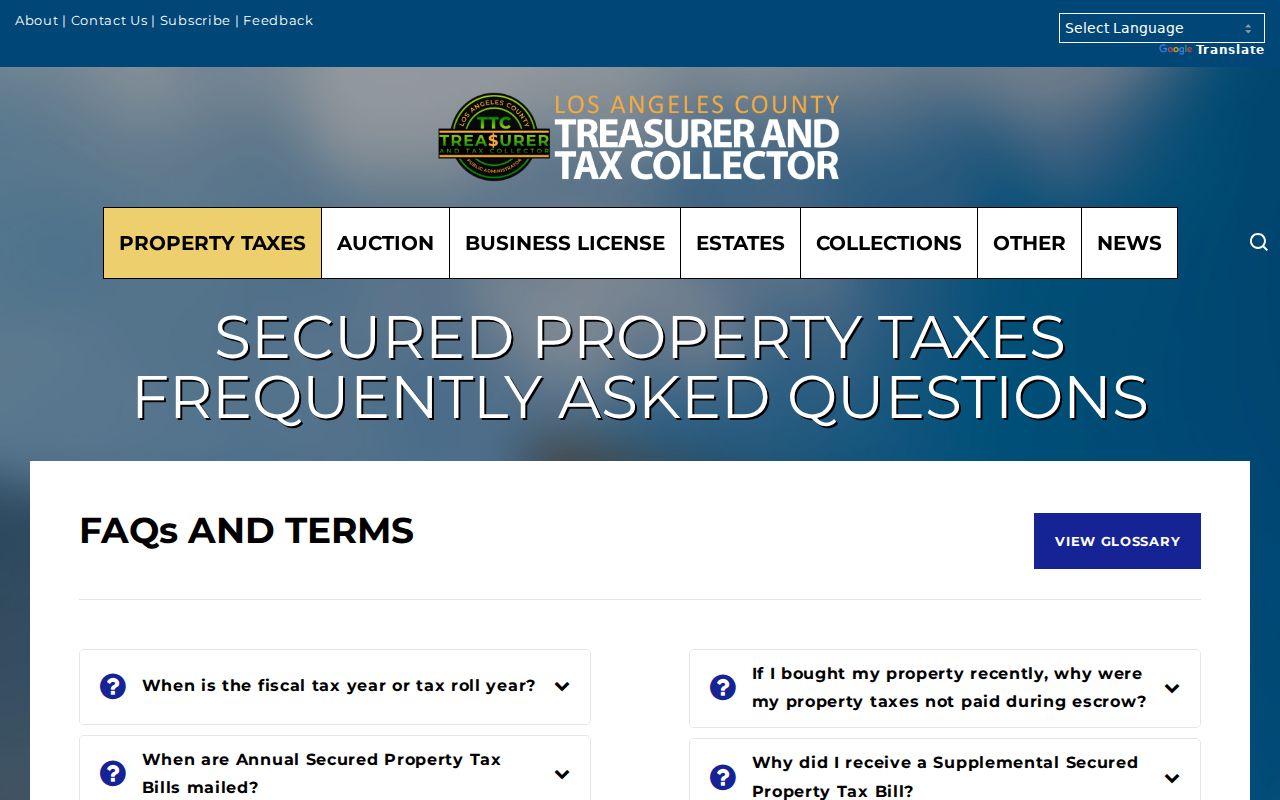
Read the tax image as a parcel and year reference. Do not convert a mailing destination into a claim about who lives at the situs.
Why the Recorder Cannot Search a West Hollywood Street
The Los Angeles County recorder's official real-estate index reaches back to 1850, but it is alphabetical by grantor, grantee, and recording year. The office says it does not maintain the public index by address or APN. That is the central West Hollywood by-address limitation. A street number must first be translated into a current party or legal-description clue through the Assessor and GIS. Only then can a researcher search the name and approximate year at Norwalk.
The recorder FAQ confirms that deeds are public, while complete documents must be purchased and the official search still requires the office index. Free viewing is available by appointment. Copy requests can move by counter, mail, fax, or online order after a document is identified. Online copy ordering is not an address search.
The recorder search FAQ captured for this project makes the address and APN limitation clear for a by-street search.
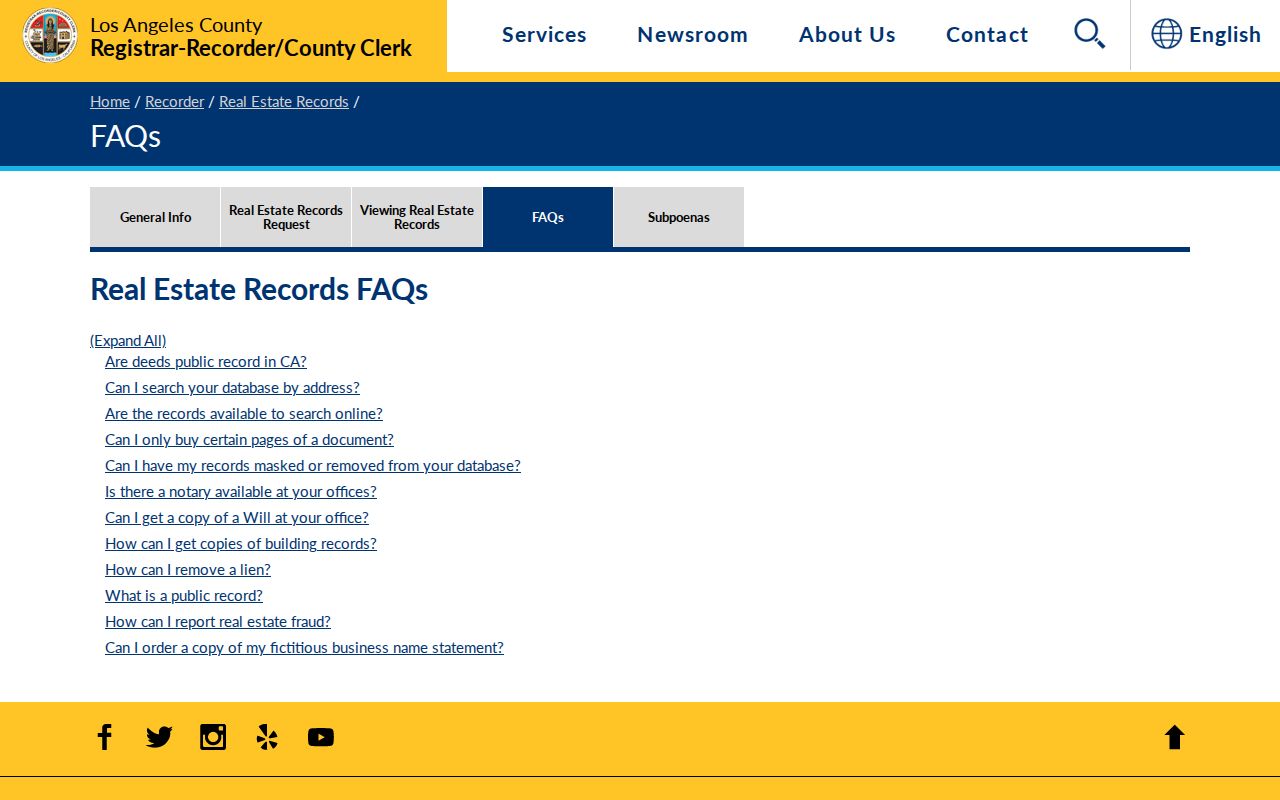
Once the index produces a document number or book-and-page reference, order the complete instrument and read its legal description rather than relying on a street label alone.
Build a West Hollywood Street Records Deed Chain
A chain of title is the sequence of recorded transfers that connects one property interest to earlier parties. Start with the current parcel clue. Identify the current acquisition instrument by searching the grantee's name and approximate recording year in the Norwalk index. On the deed, record the grantor, grantee, document number, recording date, and legal description. Then search that grantor as an earlier grantee. Repeat only after confirming that the legal description, tract, lot, block, or parcel continuity matches.
- Normalize the current address and retain unit, AIN, situs, map, and legal-description clues.
- Find the current grantee's instrument in the recorder index by name and year.
- Read the instrument and identify the prior grantor, legal description, and recording date.
- Search the prior grantor as an earlier grantee, moving backward one instrument at a time.
- Overlay directories, permits, probate, or obituaries only after the ownership sequence is stable.
For 1850 through 1957, use the lower-level index and records at Norwalk. For 1958 forward, use the second-floor facilities. The physical split is a useful date marker, not an online cutoff. A deed-chain address guide should also state that owners and listed occupants are different evidence tracks.
The recorder viewing page shows the office-based name-and-year index that anchors a West Hollywood deed chain.
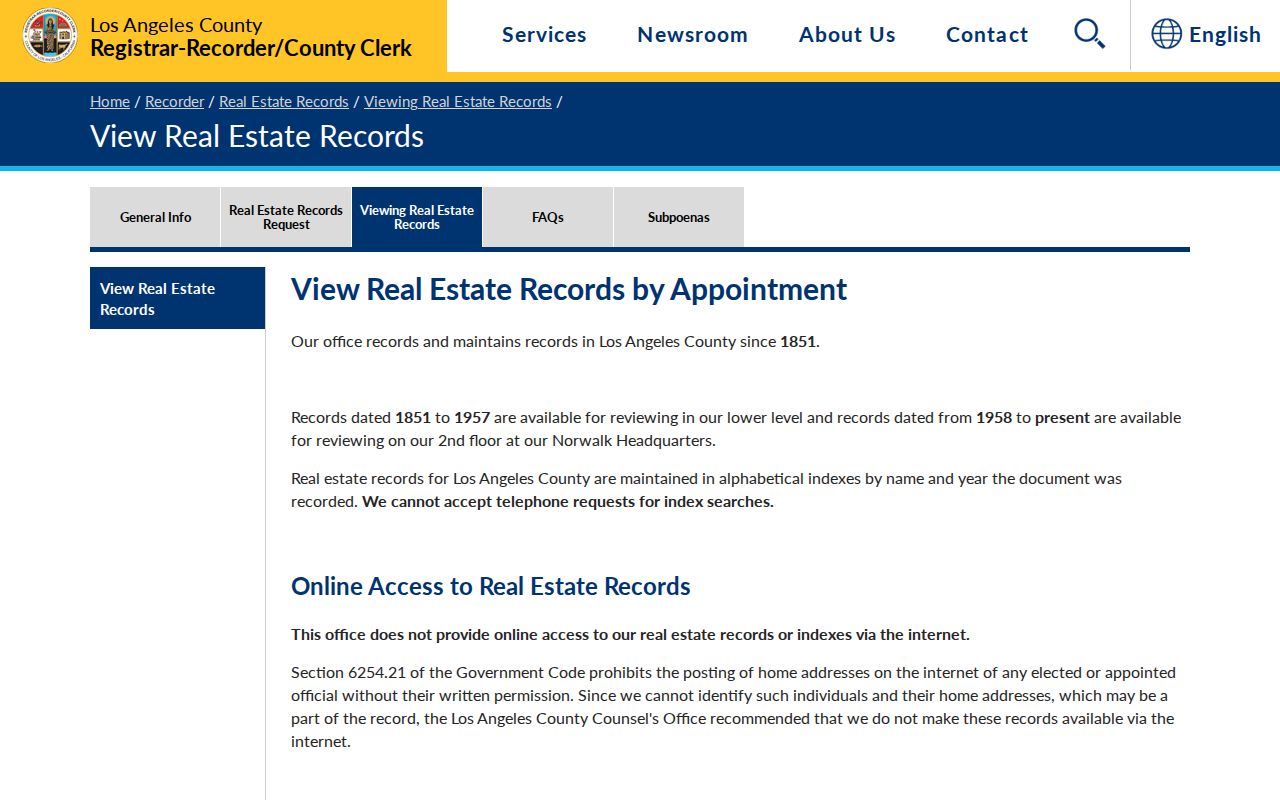
The image belongs to the index stage. It should be followed by a complete-copy request only after a document number or book-and-page clue is identified.
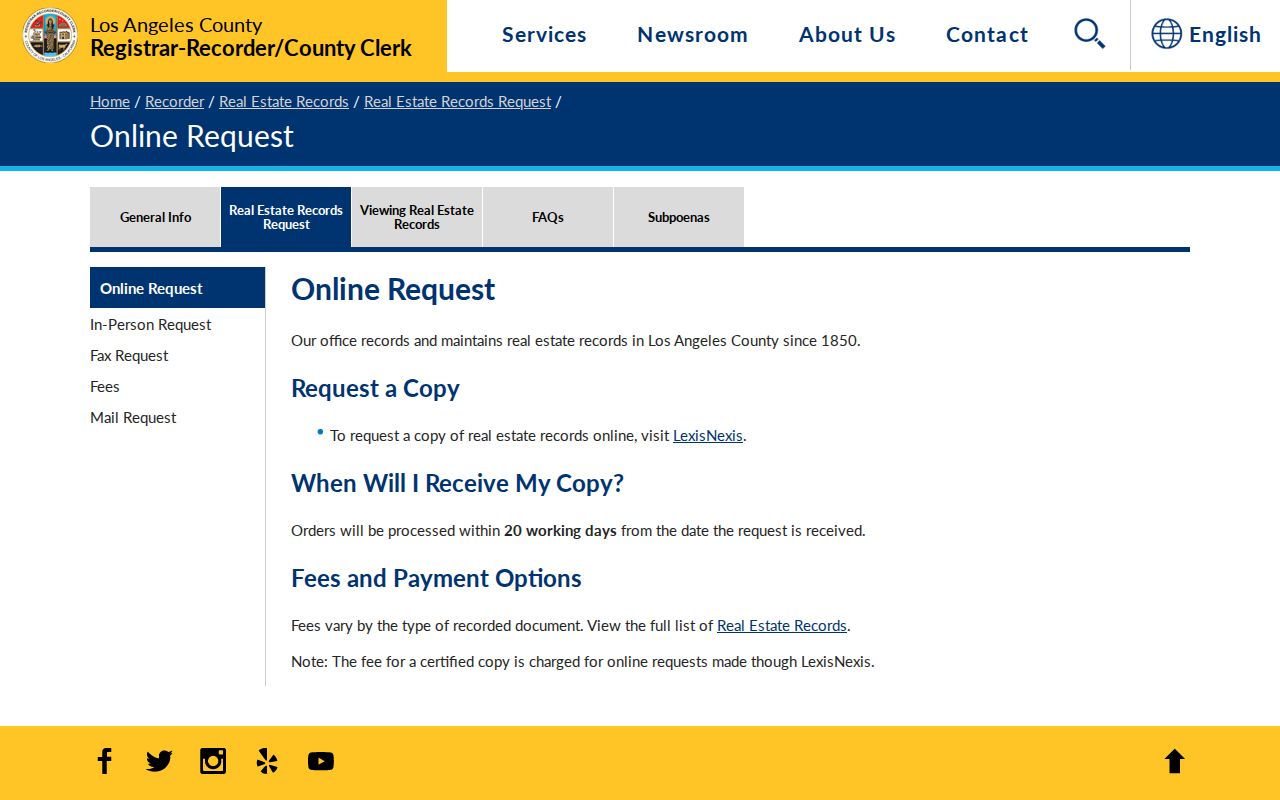
The county copy-request channel is useful after the index identifies the document. The captured request page shows the final step of obtaining a complete copy, not the beginning of the search.
Keep the instrument number and legal description with each link in the chain. Names alone can collide.
West Hollywood Street Records and Permit Dates
West Hollywood Building and Safety moved many current services into Tyler EnerGov on August 19, 2024. Applications, account history, and status can be handled through the online system, but permit history and plan duplication still go through the City Clerk. The city's permit-services instructions state the same split. A permit record can show an address, permit number, applicant, contractor, scope, valuation, and dates. It can help establish when a building changed, not who occupied it or when a sale closed.
For a focused request, name the address or AIN, the project or permit number, the date range, and the records sought. City Hall is at 8300 Santa Monica Boulevard. Building and Safety is reachable at (323) 848-6320; Planning at (323) 848-6475; the City Clerk at (323) 848-6800. Counter and virtual appointments are offered Monday through Friday in morning and afternoon blocks. Fees in the FY2024-25 schedule included a $5.03 office-record search or single permit copy, but current schedules control.
Pre-1984 files may belong to Los Angeles County because West Hollywood did not incorporate until November 29, 1984. Ask whether predecessor permit films transferred before assuming the modern city portal is complete. That cityhood seam is a West Hollywood-specific reason to preserve both the current city custodian and the county-era source.
Reverse Directories for West Hollywood Streets
A reverse, or criss-cross, directory puts the street and number before the listed adult or business. LAPL identifies runs for 1906, 1927, and 1956 through 1987, with some volumes reaching selected Los Angeles County communities. The ordinary alphabetical section can then confirm the surname, address, and any notation. Search the street guide and abbreviation key first. OCR may split a number, and older books can write an avenue, numbered street, or Broadway in more than one form.
The directory's h or r notation can separate a householder or resident entry from a business line. Wid may identify a widow or widower notation, and a spouse may appear in parentheses. Copy the page, column, volume year, and publisher. A listing records a canvass or publication moment. It does not prove ownership, current presence, or a complete household.
For a family-history question, pair one reverse-directory year with the closest released census and newspaper search. The larger historical collection, including Hollywood titles and the 1906 street guide, is covered in the West Hollywood city directory collections page.
West Hollywood Street Index and Voter Status
California voter files are not an open directory of West Hollywood streets. The county describes a Street Index and related voter-file products, but access is controlled by application, contract, applicant identity, exact geography, intended purpose, security plan, and signed certifications. Published county prices include $0.10 per page plus handling for a general-public Street Index used for political purposes, while countywide or precinct files have separate prices. Confirm the current schedule and eligibility before making a request.
The verification portal is narrower still. It asks for last name, birthdate, house number, and ZIP code to check a supplied person. Full files can include residence and mailing addresses, registration date, precinct, district, party preference, status, and participation history, while signatures, ID numbers, and Social Security fields are excluded. Casual people-finding, solicitation, and harassment are not approved uses.
A historical voter register or poll book may require California State Archives or county reference work. Aggregate Reports of Registration can show counts, not names. For a current West Hollywood street record, the voter source is a restricted, purpose-controlled layer rather than the missing household list.
What the West Hollywood Street Directory Cannot Show
Public address records do not reveal every household member, every person who receives mail, or every private customer relationship. DMV data is protected. Utility and delivery accounts are not public resident lists. A parcel owner may live elsewhere, a tax mailing address may belong to an agent, and a historical directory may omit a household because of timing, nonlisting, OCR failure, or a different community name.
Use the AIN, legal description, document number, publication year, and source date to describe what is known. Do not fill a gap with a same-name guess. If the goal changes from a whole street to one person, use the West Hollywood resident lookup page and its two-source matching workflow. If the goal is a past occupant, move to the city-directory and deed-chain collections instead of treating a current parcel result as historical proof.
Lawful personal use. West Hollywood street and address records support parcel research, family history, civic curiosity, and personal safety awareness. Using a public record to stalk, harass, intimidate, or harm another person is not lawful.
The strongest street result is a dated map-and-record trail with clear limits. It identifies land, public filings, and historical listings without claiming access to private household data.